Blog › Coloring and relaxation: the research
Coloring for Relaxation: What the Research Actually Says
Adult coloring books have been sold as stress relief, mindfulness and calm in a box. Some of that is supported by research, and some of it is marketing. Here is what the studies actually tested, what they found, where they fall short, and how to set up a coloring session that has a fair chance of helping you unwind.
The short answer
A handful of small experiments have found that people report feeling less anxious after a short coloring session, often 10 to 20 minutes, and one week-long study found lower anxiety and depressive symptoms after daily coloring. Most of those studies were done with university students, measured short-term effects, and relied on questionnaires. A 2022 meta-analysis found that coloring a mandala did not reduce anxiety more than free drawing did.
So: coloring can help some people relax, at least for a while. It is not therapy, and it is not a treatment for anxiety, depression or anything else. If worry or low mood is getting in the way of your days, talk to a doctor or a mental health professional. A coloring book can sit next to that help. It can't replace it.
What the studies actually found
These are the studies that come up most often when people say "research shows coloring reduces stress." Each one is linked in the sources below.
Curry and Kasser (2005): mandalas, plaid and a blank page
Nancy Curry and Tim Kasser first made 84 undergraduate students anxious with a short anxiety-inducing task. Then they randomly assigned them to color a mandala, color a plaid pattern, or color freely on a blank sheet. Anxiety dropped about the same amount in the mandala and plaid groups, and both dropped more than the blank-page group. The authors suggested that coloring a structured, reasonably complex pattern may help people settle into a meditative state.
A replication by Renée van der Vennet and Susan Serice (2012) used the same three conditions. In their version, the mandala group showed a bigger drop in anxiety than both the plaid and the blank-page groups.
Eaton and Tieber (2017): choosing your own colors
Judy Eaton and Christine Tieber split 85 undergraduates into two groups. One group colored an image with any colors they liked. The other had to copy the colors from a pre-colored version. Both groups benefited, but the free-choice group showed a bigger drop in anxiety and more perseverance on a task afterward. The authors' takeaway was that the most helpful coloring balances structure (an outline to follow) with real choices (your colors, your way).
Flett and colleagues (2017): one week of daily coloring
This study from the University of Otago randomly assigned 104 female university students to color every day for a week or to do logic puzzles every day for a week. Before and after, they filled in questionnaires on depressive symptoms, stress, anxiety, flourishing, resilience and mindfulness. The coloring group showed significantly lower depressive symptoms and anxiety afterward. The puzzle group did not. The authors called their evidence preliminary and described coloring as a possible low-cost self-help tool for people without a clinical diagnosis.
Mantzios and Giannou (2018): does coloring make you mindful?
Michail Mantzios and Kyriaki Giannou ran two small experiments with university students. In the first (88 students), unguided mandala coloring did no better than free drawing, and neither group became measurably more mindful. In the second (72 students), one group colored a mandala while a mindfulness practitioner guided them through it, much like a breathing meditation. That guided group showed a bigger drop in anxiety than the group coloring on their own, but mindfulness scores still did not change. In exit interviews, some participants said they did not like having a voice talk them through it.
Holt, Furbert and Sweetingham (2019): mood, attention and ideas
Nicola Holt and colleagues ran two crossover experiments with undergraduates (47 and 52 people), so every participant tried both coloring and a comparison activity. According to the university's summary, the comparison was reading a study-skills chapter, and the coloring session was 20 minutes with a mandala. In both experiments, coloring reduced anxiety and increased mindfulness compared with the control condition. Participants also did better afterward on a selective attention task and came up with more original ideas on a creativity test.
The meta-analysis (2022): mandalas versus free drawing
Siri Jakobsson Støre and Niklas Jakobsson pooled eight studies with 578 participants that compared mandala coloring with free drawing. Mandalas did not reduce state anxiety significantly more than free drawing. The less precise studies tended to show bigger effects, which the authors read as a sign of some bias toward finding an effect. Their conclusion: both activities seem about equally useful for reducing anxiety, and more high-quality studies are needed before anyone makes confident recommendations.
The studies at a glance
| Study | Who took part | Compared with | Main result |
|---|---|---|---|
| Curry & Kasser 2005 | 84 undergraduates | Plaid pattern, blank page | Mandala and plaid lowered anxiety more than a blank page |
| Eaton & Tieber 2017 | 85 undergraduates | Copying set colors | Free color choice lowered anxiety more |
| Flett et al. 2017 | 104 female students, 1 week | Daily logic puzzles | Lower anxiety and depressive symptoms after coloring |
| Mantzios & Giannou 2018 | 88 and 72 students | Free drawing; guided coloring | No change in mindfulness; guided coloring lowered anxiety more |
| Holt et al. 2019 | 47 and 52 undergraduates | Control activity | Less anxiety, more mindfulness, better attention |
| Støre & Jakobsson 2022 | 8 studies, 578 people | Free drawing | Mandalas no better than free drawing |
What the research can't tell you yet
The results are encouraging, but they are a long way from "coloring cures stress." A few honest caveats:
- Small, similar samples. Most participants were university students, often mostly women. That says little about a 45-year-old nurse after a night shift or a retiree who can't sleep.
- Short time frames. The lab sessions were short, for example 10 minutes in the Mantzios and Giannou study and 20 minutes in the Holt studies, and the longest study above ran for one week. Nobody here followed people for months.
- Self-reported feelings. Most outcomes came from questionnaires filled in right after coloring. Those are useful, but they are not the same as lasting change.
- Coloring isn't special compared with everything. Free drawing did about as well as mandalas in the meta-analysis. The fair conclusion is that a calm, absorbing activity with your hands may help, and coloring is one easy way to get one.
- No clinical claims. These studies were not testing coloring as a treatment, and they mostly did not include people with a diagnosed condition.
It also helps to know that art therapy is a different thing: it is a mental health profession, with a trained therapist. Coloring a page on your sofa is a hobby, and that is fine.
Why a page might help you settle
The researchers offer a few explanations, and they are worth reading as ideas rather than proven mechanisms. Curry and Kasser pointed to the structure of a pattern. Eaton and Tieber pointed to the balance between structure and choice. Mantzios and Giannou wondered whether the benefit comes from flow, the state of being absorbed in a task.
All three line up with what coloring is like in practice. There is an outline, so you never face a blank page. There are choices, but small ones. And there is an end: the page is done when the shapes are filled. That is a very different evening from scrolling, which has no outline and no end.
Why bold and easy pages lower the "I'll ruin it" pressure
Plenty of people buy a detailed coloring book, color one leaf, and put it away because it suddenly felt like a test. That is the opposite of relaxing.
Bold and easy pages take some of the pressure off. Thick outlines mean a wobbly stroke doesn't cross into the next shape. Big shapes mean fewer decisions and fewer chances to feel you made the wrong one. And a page you can finish in one evening gives you the small satisfaction of being done.
A few habits help too:
- Print a practice copy. With a printable page you can color one version "properly" and one just to try colors. The free pages are good for this.
- Choose your own colors. Eaton and Tieber's free-choice group did better than the group copying set colors. There is no correct color for a sofa.
- Lower the bar on purpose. Decide before you start that this page is for you, not for Instagram.
How to set up a calm coloring session
None of this is required. It is just a setup that tends to work.
- Pick a time and an end time. Twenty minutes after dinner, or the half hour before bed. A fixed end keeps it a break instead of another task.
- Put the phone somewhere else. Not face down next to you. In another room, if you can.
- Choose one page and five or six colors. A short palette means fewer decisions. If you need help, here is how to pick colors that work together.
- Put on sound you don't have to follow. More on that below.
- Start with the biggest shape. A wall or a sofa gets you going without fiddly decisions.
- Stop when the time is up, even mid-page. Leave the page out. Coming back to a half-finished page tomorrow is half the fun.
A screen-free wind-down
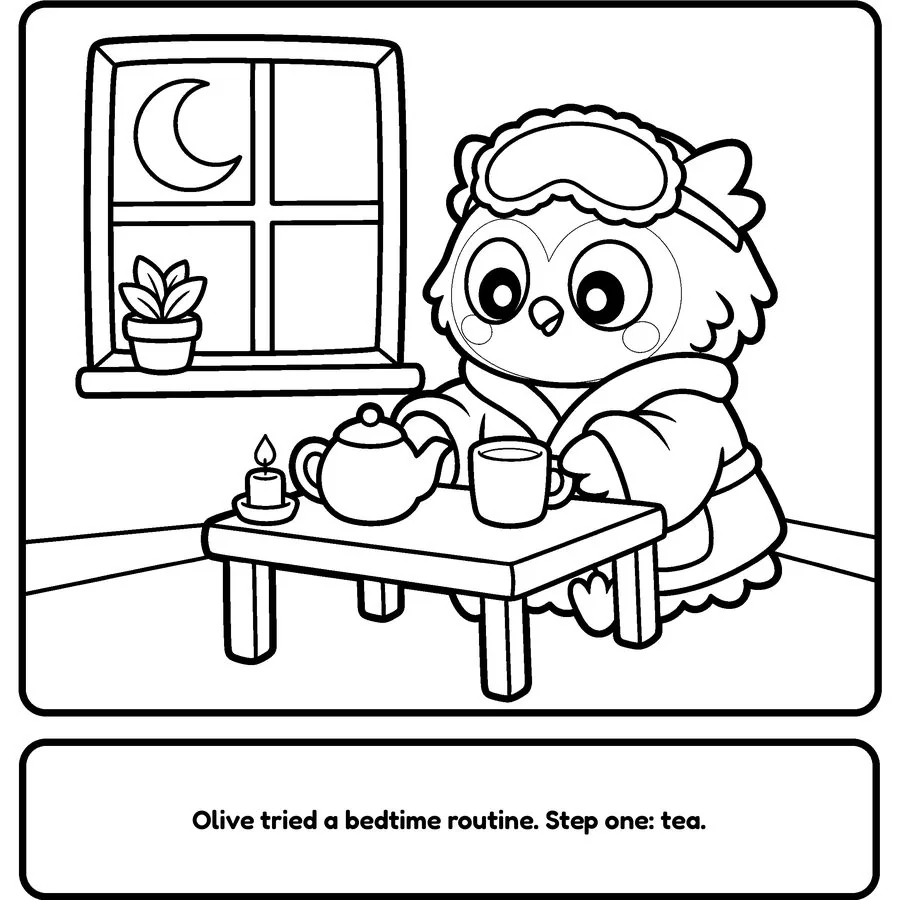
If you color in the evening to wind down, paper has one obvious advantage: it is not another glowing screen with notifications on it. Keep the session simple. Tea, a lamp, one page. If you would rather color digitally, that works too, but turn notifications off first. Our guide to coloring on an iPad covers the setup.
A small coloring corner
You don't need a craft room. A corner of the sofa with a good lamp, a lap tray or a clipboard, and a box that holds your pens, a spare sheet to slip behind the page, and the page you are working on is plenty. When the box is already packed, starting takes ten seconds instead of ten minutes, and that is often the difference between coloring and scrolling.
Playlists, audiobooks and podcasts
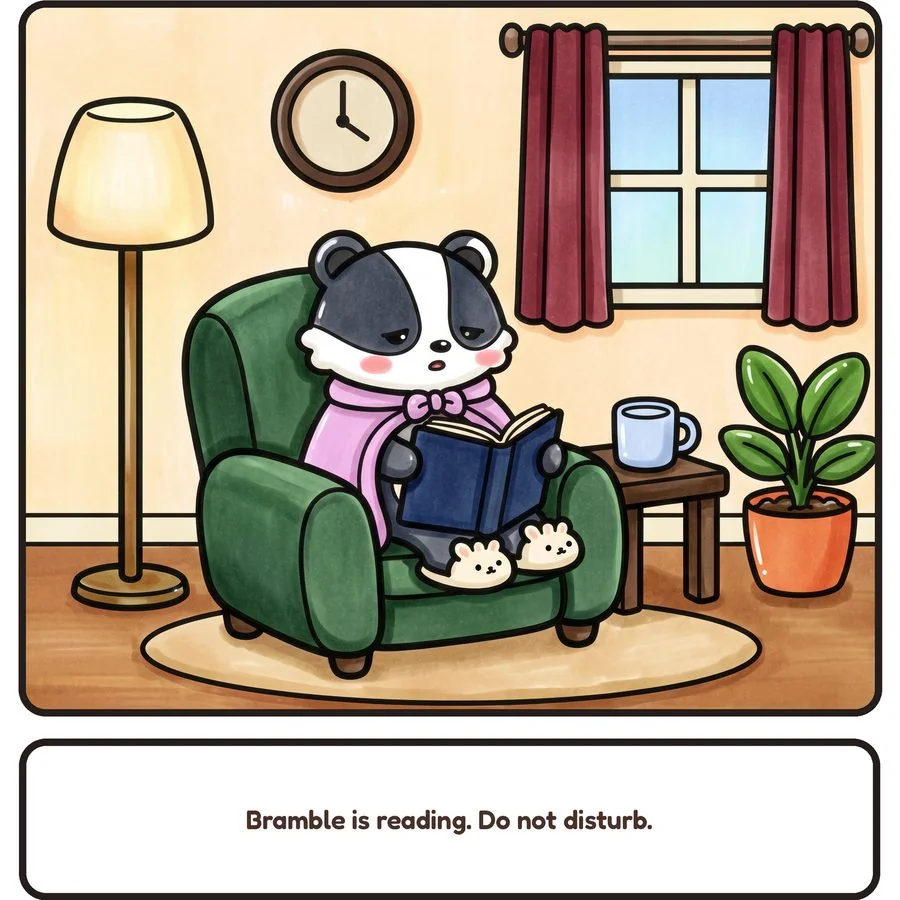
Instrumental music, a familiar audiobook or a podcast you have heard before all work well, because you can drift in and out without losing the thread. Gripping true crime may keep your hands busy, but it will not do much for your shoulders.
Coloring with other people
Coloring is one of the few hobbies you can do while talking without doing either one badly. A few easy ways to try it:
- At the kitchen table. Print one page per person. Nobody has to be good at drawing.
- At book club. Color while you talk about the book. Or while you admit nobody read it.
- On a video call. Pick the same page, color for half an hour, show each other the results at the end.
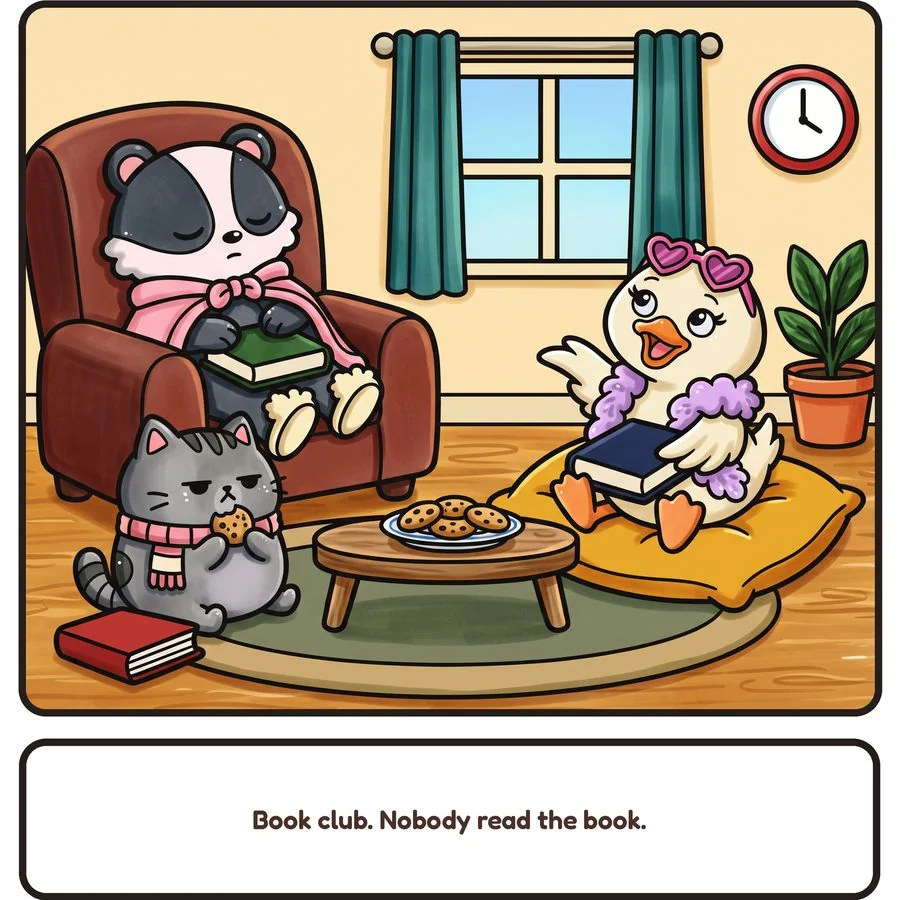
One lesson from the Mantzios and Giannou study: some people disliked being guided through their coloring by a voice. In a group, let people talk or stay quiet as they like. Nobody should be told how to relax.
When a coloring page isn't enough
Coloring is a pleasant way to spend twenty minutes, and for some people it takes the edge off a hard day. If you notice that you are coloring to get through every evening, or worry and low mood aren't lifting, that is a reason to reach out to someone, not to buy a thicker book. A doctor, a counselor or a helpline in your country can point you in the right direction.
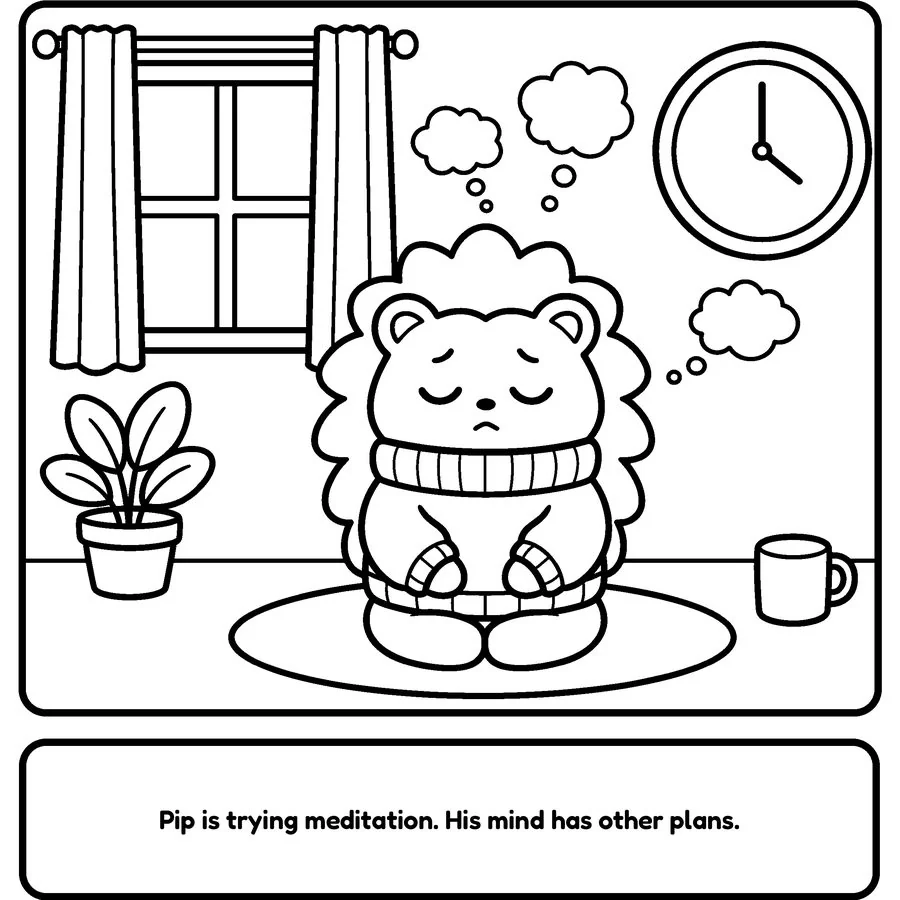
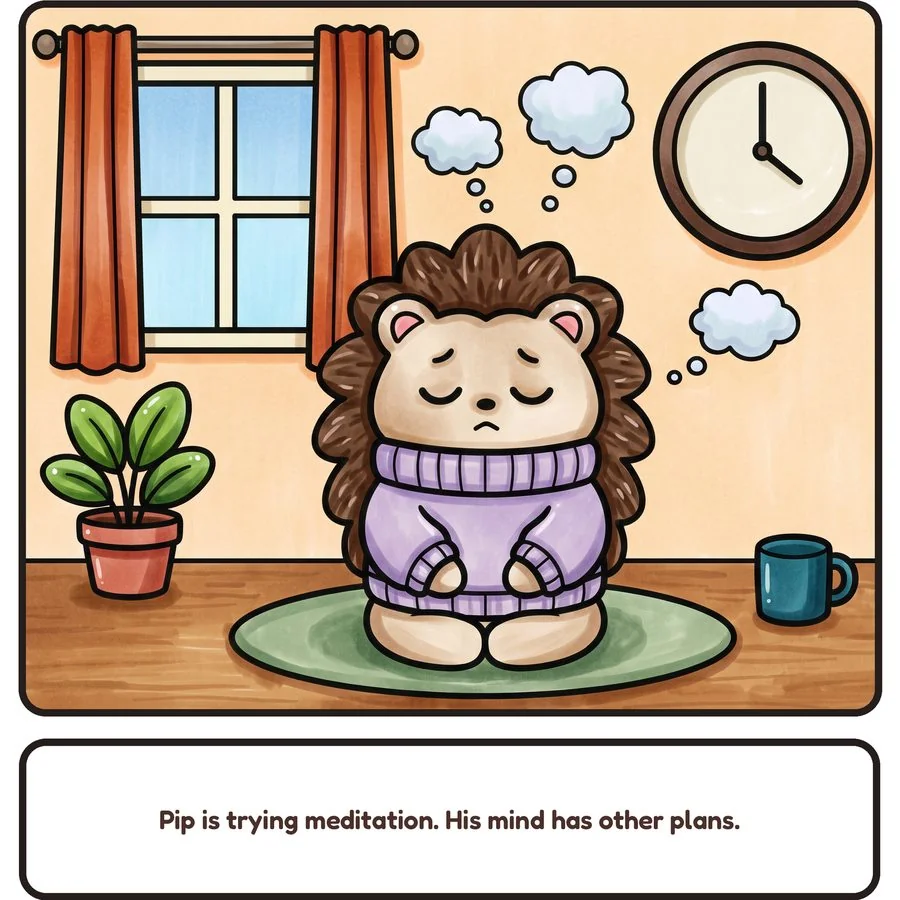
If what you need is a quiet half hour with a funny page and a cup of tea, start with a free page. Pip, our worried hedgehog from I'm Fine, Probably, and Olive the night owl from Just Five More Minutes both have pages waiting.
Questions people ask
Is adult coloring proven to reduce stress?
Not proven in a strong sense. Several small studies found that people reported less anxiety after short coloring sessions, and one week-long study found lower anxiety and depressive symptoms. Most used university students and short time frames, and a 2022 meta-analysis found mandala coloring no better than free drawing.
Is coloring a form of therapy?
No. Coloring on your own is a hobby. Art therapy is a mental health profession practiced by trained therapists. Coloring can be a pleasant way to relax, but it is not a treatment for anxiety, depression or any other condition.
Do mandalas work better than other coloring pages?
Some early studies found mandalas lowered anxiety more than coloring on a blank page. But a 2022 meta-analysis of eight studies found mandala coloring did not reduce anxiety significantly more than free drawing. Pick the pages you actually enjoy.
How long should I color to feel calmer?
The lab studies used short sessions, for example 10 minutes in one and 20 minutes in another, so a short session is a reasonable place to start. There is no proven ideal length. A fixed end time helps coloring stay a break rather than another job.
Can I color on a tablet instead of paper?
Yes, though the studies above used paper. If you color digitally to wind down, turn off notifications so the session doesn't turn into checking your messages.
Sources
- Curry, N. A. & Kasser, T. (2005). Can coloring mandalas reduce anxiety? Art Therapy, 22(2), 81–85
- van der Vennet, R. & Serice, S. (2012). Can coloring mandalas reduce anxiety? A replication study. Art Therapy
- Eaton, J. & Tieber, C. (2017). The effects of coloring on anxiety, mood, and perseverance. Art Therapy, 34(1), 42–46
- Flett, J. A. M. et al. (2017). Sharpen your pencils: Preliminary evidence that adult coloring reduces depressive symptoms and anxiety. Creativity Research Journal, 29(4), 409–416
- Mantzios, M. & Giannou, K. (2018). When did coloring books become mindful? Frontiers in Psychology, 9, 56
- Holt, N. J., Furbert, L. & Sweetingham, E. (2019). Cognitive and affective benefits of coloring: Two randomized controlled crossover studies. Art Therapy
- Medical Xpress (3 May 2018). Colouring reduces stress and boosts creativity, study finds (UWE Bristol summary of the Holt studies)
- Støre, S. J. & Jakobsson, N. (2022). The effect of mandala coloring on state anxiety: A systematic review and meta-analysis. Art Therapy
 Free Christmas coloring pages for adults
 How to print coloring pages at home
 How to color printable pages on an iPad